Bruges in one day: Market Square, Belfry, canals and Beguinage
Bruges is compact enough to see its key places in one day on foot: the Beguinage and the Lake of Love in the south, the canals around the Rosary Quay, Burg Square and the Market Square with the Belfry. This plan starts at the railway station and ends in the evening in the old port district. The order is a suggestion; if you arrive early, you can also put the Belfry first.
Photos from Wikimedia Commons; author, source and licence are shown below each image.
Why Bruges works well for a day on foot
According to Visit Bruges, the canals linked the city to the sea for centuries and helped make it one of the great Hanseatic cities. Bruges flourished as never before in the 15th century, and large parts of its medieval heritage have survived almost intact. That is why UNESCO designated the entire historic city centre as a World Heritage site. For visitors, this means that all the well-known places are only a few minutes’ walk apart. You do not need a car in the old town, and several streets are car-free at certain times. Wear comfortable shoes, as cobblestones are almost everywhere, and pack a rain jacket in changeable weather.
Getting there by train or car
If you come by train, get off at Brugge station, not Brugge Sint-Pieters, which lies in the north-east of the city. From Brugge station the historic centre is within walking distance, and De Lijn buses also run into the centre. According to Visit Bruges, three trains an hour run every day from Brussels-South to Bruges, and the journey takes about an hour. If you drive, the city recommends the free park-and-ride sites on the edge of town or the underground car parks Centrum-’t Zand, about ten minutes’ walk from the Market Square, and Centrum-Station, about twenty minutes away. At Centrum-Station the bus ride to the centre is included in the parking ticket.
Morning: Lake of Love and Beguinage
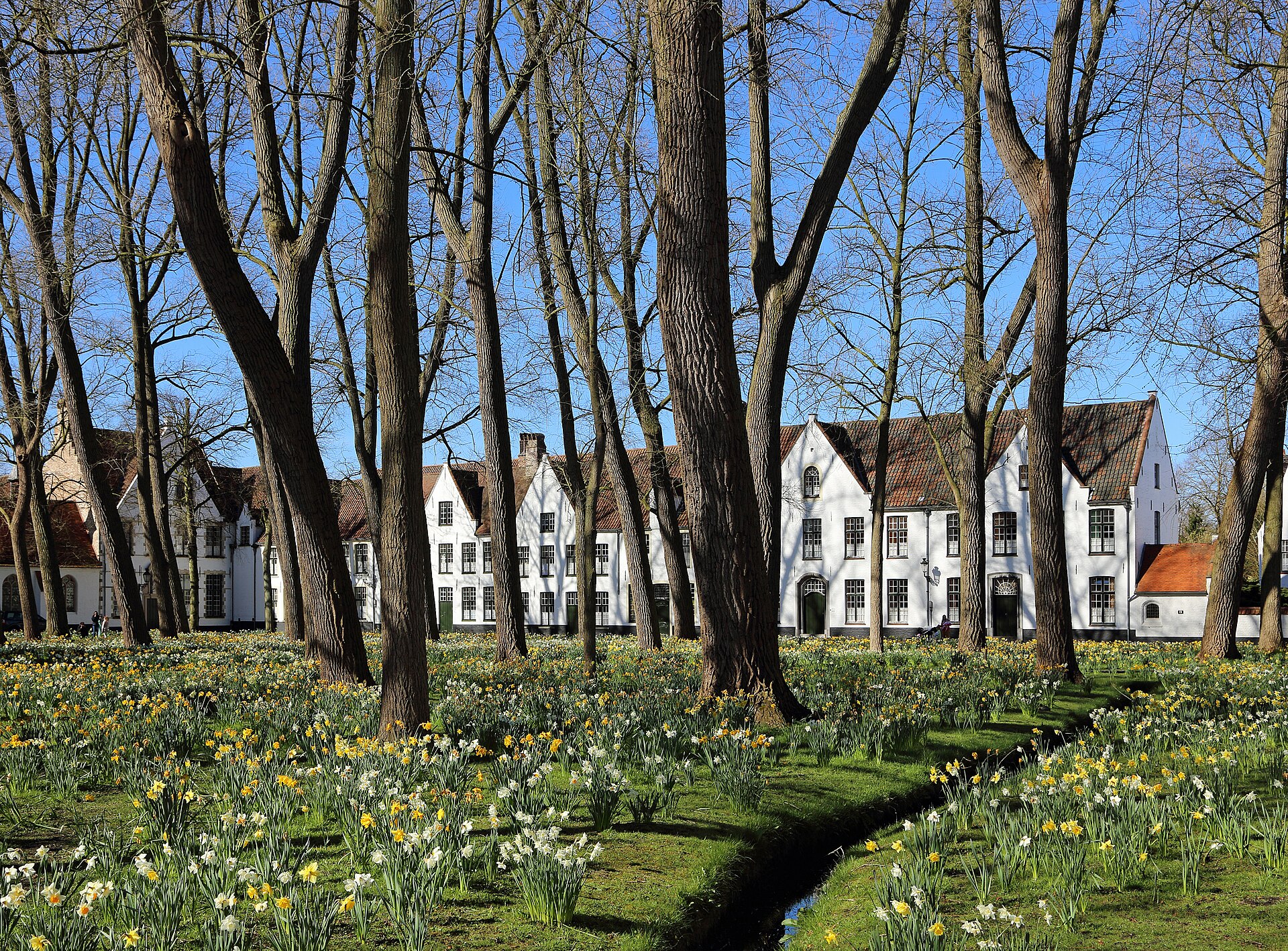
From the station it is not far to the Minnewater, the so-called Lake of Love. According to Visit Bruges, the name comes from an old belief that water nymphs, “minnen” in Dutch, lived here. The best views are from the bridge and from the old lockhouse. Right next to it is the Princely Beguinage Ten Wijngaerde, founded in 1245, with white-painted houses around a quiet garden with tall trees. Since 1998 it has been a UNESCO World Heritage site together with twelve other Flemish beguinages. Entry is free, but people still live here: the city explicitly asks visitors to walk through the Beguinage in silence and respect its calm.
Church of Our Lady and the Dijver
Heading north, you pass the Church of Our Lady. Visit Bruges describes its tower as the second-highest brick church tower in the world, and you can see it from many points in the old town. Part of the church is set up as a museum, which requires a ticket. A few steps further on, the Dijver begins, a tree-lined canal with bridges. Here you will also find the Gruuthuse Museum, which guides you through three key periods of the city’s history, and the Groeninge Museum with works by Flemish Primitives such as Jan van Eyck and Hans Memling. With only one day, choose one museum at most.
Rosary Quay and a canal boat trip
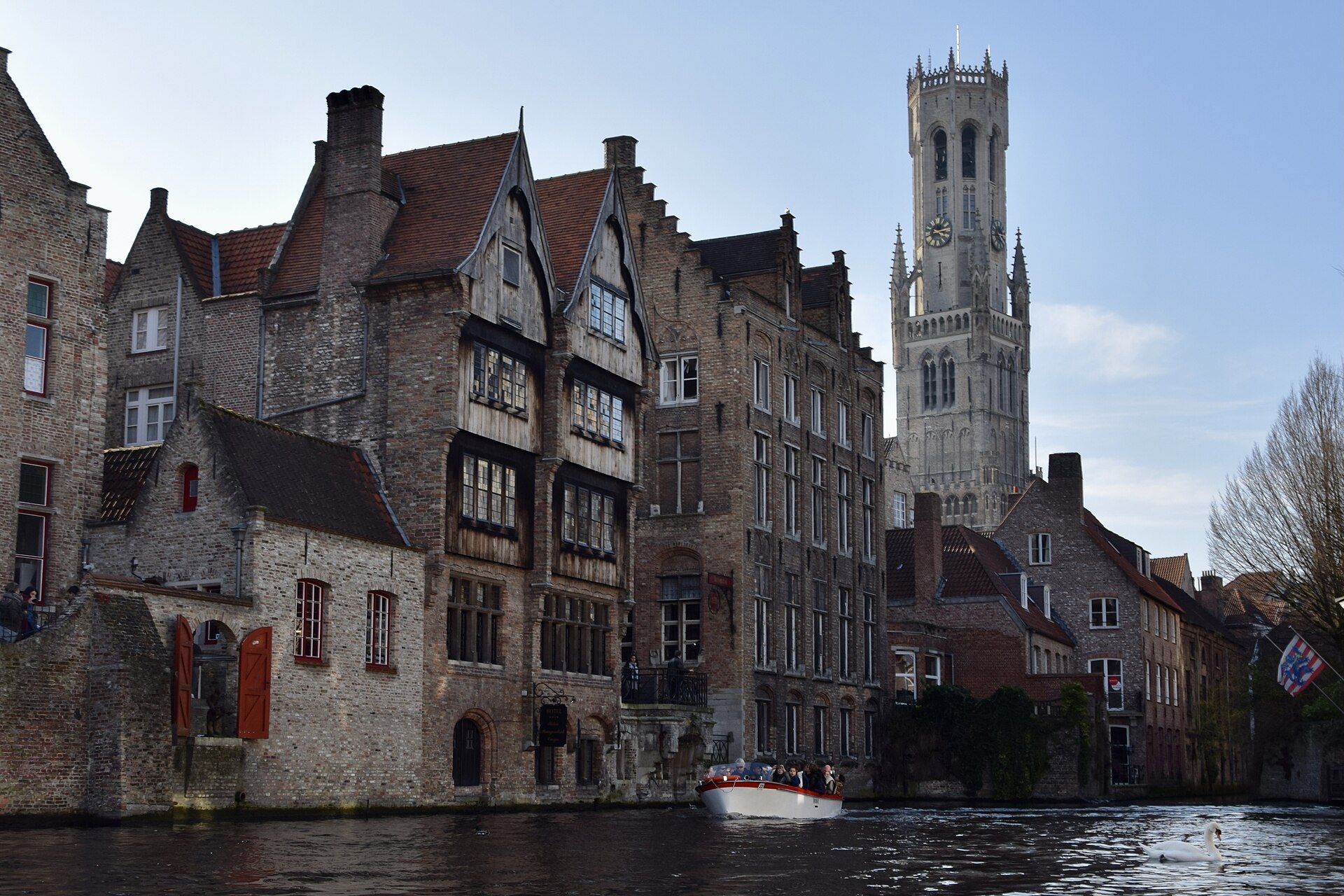
According to Visit Bruges, the Rozenhoedkaai, or Rosary Quay, is the most popular photo spot in the city; rosaries were once sold here. From the quay you see old brick houses above the water with the Belfry behind them. The canal boats depart nearby. Five boat companies have their own landing stages, including at the Rosary Quay, on Wollestraat and on Huidenvettersplein. They all follow the same route between Jan van Eyck Square and the Beguinage, and the tour lasts half an hour without stops. Tickets are only sold at the jetty, not in advance. According to Visit Bruges, they cost 15 euros for adults and 9 euros for children aged 4 to 11 until the end of 2026.
Burg Square: the political heart
Visit Bruges describes the Market Square as the heart of the city and Burg Square as its soul. For centuries, the Burg was the centre of power in Bruges, and the city administration still sits in the Gothic City Hall, built between 1376 and 1421 and one of the oldest in the Low Countries. Around the square stand buildings from different periods, including the Basilica of the Holy Blood, which was given basilica status in 1923, and the Liberty of Bruges. The square works like a compact guide to architectural history. The basilica is a place of worship, so please enter quietly and respectfully, especially during services.
Market Square and Belfry: 366 steps above the city
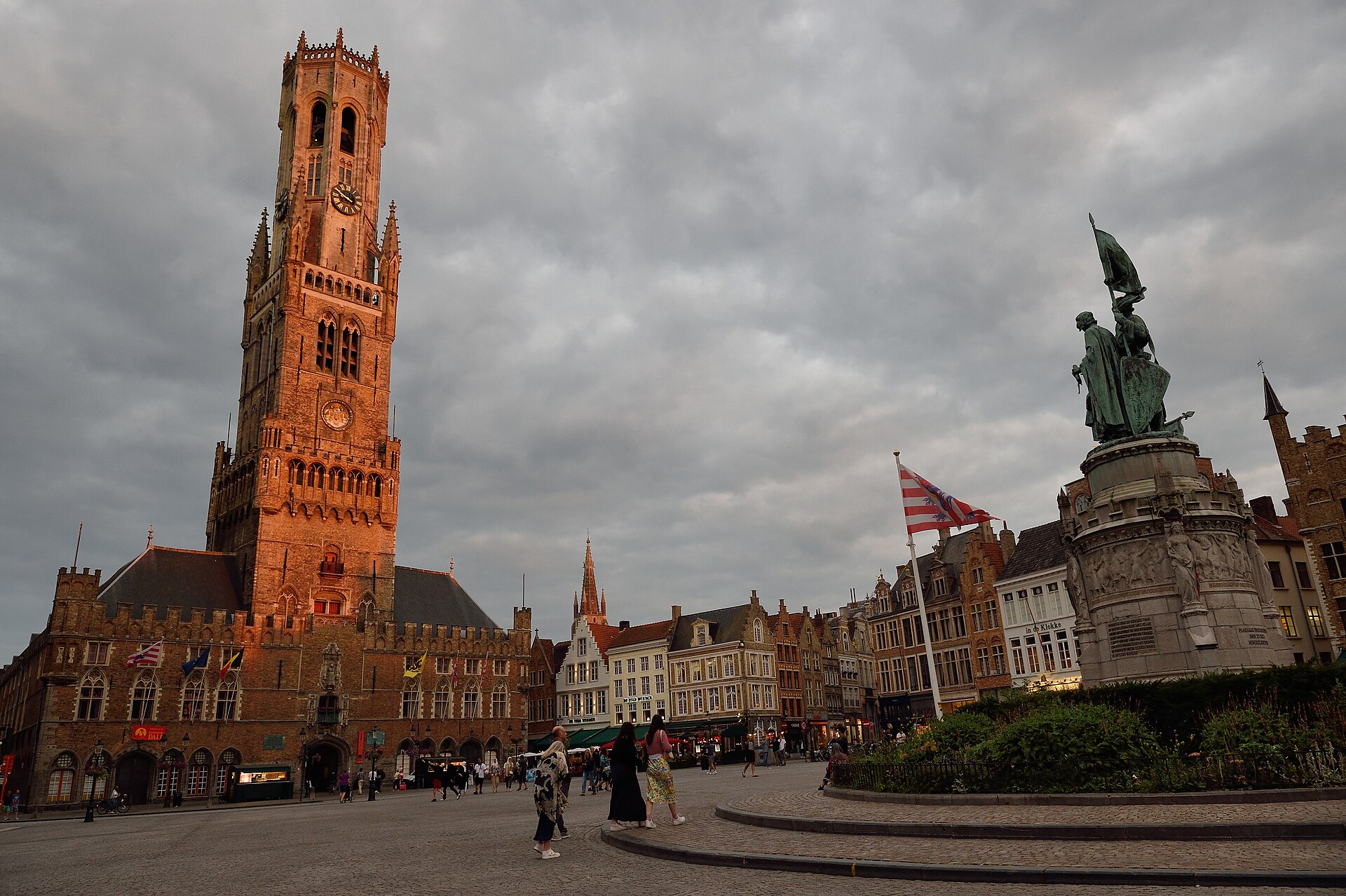
From Burg Square it is only a few steps to the Market Square with the 83-metre Belfry. The tower was built in several phases between the 13th and 15th centuries and, since 1999, has been on the UNESCO World Heritage List together with other belfries in Belgium and France. If you climb the 366 steps, you pass the treasury, the huge drum room of the carillon and the room of the city carillonneur. At the top the bells ring every quarter of an hour, and Musea Brugge advises protecting your ears. The climb is not accessible. Without climbing, the free view from the courtyard of the City Halls is worthwhile. The 47-bell carillon is played on Wednesdays, Saturdays and Sundays from 11 am to noon.
Tickets, opening hours and an evening in the Hanseatic Quarter
According to Musea Brugge (as of October 2026), the Belfry costs 16 euros, or 15 euros on weekdays between 3 November and 31 March; children under seven go free. In the summer season it opens daily from 9 am to 8 pm; in winter from 10 am to 6 pm on weekdays and Sundays, with longer hours on Saturdays. Last entry is one hour before closing, and because it gets busy, booking online is recommended. To end the day, walk to Jan van Eyck Square in the old port district. From the 13th to the 15th century, Bruges was a trading hub between the Hanseatic cities, England and southern Europe, which the Burghers’ Lodge still recalls.
Frequently asked questions
Is one day enough for Bruges?
One day is enough for the Beguinage, the canals, Burg Square, the Market Square and the Belfry if you walk and visit one museum at most. For the museums of Flemish painting or a trip to the coast, plan an overnight stay.
Do I need to book the boat trip in advance?
No, individual visitors cannot reserve boat trips. Tickets are sold at the five landing stages. According to Visit Bruges, boats are guaranteed to run daily from 10 am to 6 pm from March to October, and in winter at least one jetty is open each day.
Which railway station should I use?
Brugge station. From there you can walk into the old town or take a De Lijn bus. Brugge Sint-Pieters lies north-east of the centre and is less practical for visiting the historic city.
Sources & current information
- Visit Bruges — UNESCO World Heritage City
- Visit Bruges — Top 12 sights
- Musea Brugge — Belfort (Belfry)
- Visit Bruges — Bruges by boat
- Visit Bruges — Begijnhof (Beguinage)
- Visit Bruges — Travelling to and in Bruges
Prices, opening hours and timetables can change. Check them via the official sources linked above before you travel.